1. Introduce a point particle having single degree of freedom. The system's Lagrangian is described as $L = L(q, \dot{q}, t)$. Assume the point particle started moving at $P_1$ when time is $t=t_1$ and arrived at $P_2$ when time is $t=t_2$. Let us introduce the action integral: $S$ defined as $$S = \int^{t_2}_{t_1} L dt.$$According to principle of least action, the motion of the point particle is constrained so that the value of S to be minimum. This implies that when the motion is to be a bit off from the proper path $(q+\delta q, \dot{q}+\delta{\dot{q}})$, the action integral does not change against any kind of $\delta q$ and $\delta \dot{q}$. Thus,$$\delta S = \delta \int^{t_2}_{t_1} L dt = 0.$$Based on the relation above, derive Euler-Lagrange equation;$$\frac{\partial L}{\partial q} - \frac{d}{dt} \left( \frac{\partial L}{\partial \dot{q}} \right) = 0.$$ Note that the $P_1$: start and $P_2$: end are fixed and $\delta(t_1) = \delta(t_2) = 0$. Furthermore, $\delta q$ and $\delta \dot{q}$ is so small that you may ignore all terms higher than the second order.
solution
$$\delta L = \frac{\partial{L}}{\partial{q}} \delta q + \frac{\partial L}{\partial \dot{q}} \delta \dot{q}$$
Use integration by parts,
$$\int \frac{\partial L}{\partial \dot{q}} \delta \dot{q} dt = - \int \frac{d}{dt} \Big( \frac{\partial L}{\partial \dot{q}} \Big) \delta q dt + \left[ \frac{\partial L}{\partial \dot{q}} \delta q \right]$$
Then,
$$\delta S = \int^{t_2}_{t_1} \delta L dt = \int^{t_2}_{t_1} \left( \frac{\partial L}{\partial q} \delta q + \frac{\partial L}{\partial \dot{q}} \delta \dot{q} \right) dt$$
$$= \left[ \frac{\partial L}{\partial \dot{q}} \delta q \right]^{t_2}_{t_1} + \int^{t_2}_{t_1} \left\{ \frac{\partial L}{\partial q} - \frac{d}{dt}\left( \frac{\partial L}{\partial \dot{q}} \right) \right\} \delta q dt = 0$$
Thus,
$$\frac{\partial L}{\partial q} - \frac{d}{dt}\left( \frac{\partial L}{\partial \dot{q}} \right) = 0$$
2. Assume a system that the Lagrangian is constant against translation of the coordinate $q \rightarrow q + \Delta q$. In that context, $p$ conserves. $$p \equiv \frac{\partial L}{\partial \dot{q}}$$ This can be understood from Euler-Lagrange equation; the first term of the equation is to be 0. This also corresponds to the law of the conservation of momentum. Meanwhile, when the Lagrangian is constant against translation of time $t \rightarrow t + \Delta t$, show the energy conservation described as following equation. Hint; solve total differential of L.
solution
The answer should satisfy $dE = 0$.
$$E = p\dot{q} - L \implies dE = d(p\dot{q}) - dL$$
Also,
$$dL = \frac{\partial L}{\partial q} dq + \frac{\partial{L}}{\partial \dot{q}} d\dot{q} + \frac{\partial L}{\partial t} dt$$
Here, $\frac{\partial L}{\partial t} = 0$, $\frac{\partial L}{\partial \dot{q}} = p$, and $\frac{\partial L}{\partial q} = \dot{p}$ (from Euler-Lagrange). Thus,
$$dL = \dot{p} dq + p d\dot{q} = d(p\dot{q})$$
Substitute this back,
$$dE = d(p\dot{q}) - d(p\dot{q}) = 0$$
3. As shown in Fig. 2.3.1, at the cylindrical coordinate system, the point particle having mass of $m$ moves smoothly along with the wire which is fixed to $z = f(r)$. $f(0) = 0$, the wire is continuous and $f(r)$ can be differentiable.
(1) Describe this system's Lagrangian $L$ using $m, g, \omega, r, \dot{r}, f, f'(=\frac{df}{dr})$. Note that the Lagrangian is $L = T - U$, where $T$ is the kinetic energy and $U$ is the potential energy.
solution
The location of the point particle in orthogonal coordinate system is,
$$(x, y, z) = (r\cos{\omega t}, r\sin{\omega t}, f(r)).$$
Differentiate with respect to $t$:
$$(\dot{x}, \dot{y}, \dot{z}) = (\dot{r}\cos{\omega t} - r\omega\sin{\omega t}, \dot{r}\sin{\omega t} + r\omega \cos{\omega t}, \dot{r}f')$$
Thus,
$$v^2 = \dot{x}^2 + \dot{y}^2 + \dot{z}^2 = \dot{r}^2 + r^2\omega^2 + \dot{r}^2(f')^2$$
$$L = T - U = \frac{1}{2} m (\dot{r}^2 + r^2\omega^2 + \dot{r}^2(f')^2) - mgf(r)$$
(2) When the point particle remains stationary ($\dot{r} = 0$), substitute L into the Euler-Lagrange equation, then describe $f(r)$ using $g, \omega, r$.
solution
Substitute $L$ into the Euler-Lagrange equation for $r$:
$$\frac{d}{dt} \left( \frac{\partial L}{\partial \dot{r}} \right) = m\ddot{r}(1 + (f')^2) + 2m\dot{r}^2 f' f''$$
When $\dot{r} = \ddot{r} = 0$, the LHS becomes 0.
$$\frac{\partial L}{\partial r} = mr\omega^2 - mgf'(r) = 0$$
$$f'(r) = \frac{\omega^2}{g} r \implies \frac{df(r)}{dr} = \frac{\omega^2}{g}r$$
$$f(r) = \frac{\omega^2}{2g} r^2 + C$$
From the initial condition $f(0) = 0$, we get $C = 0$.
$$f(r) = \frac{\omega^2}{2g} r^2$$
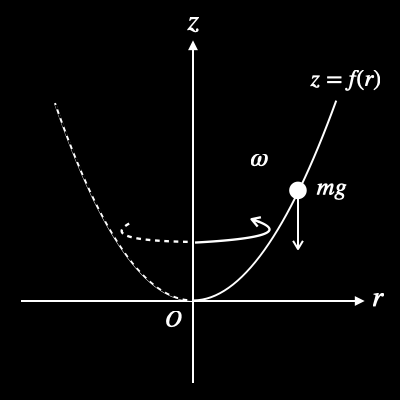 Fig. 2.3.1